Your Hands Remember the Wrong Game: The Science of Muscle Memory Collapse When You Switch Titles
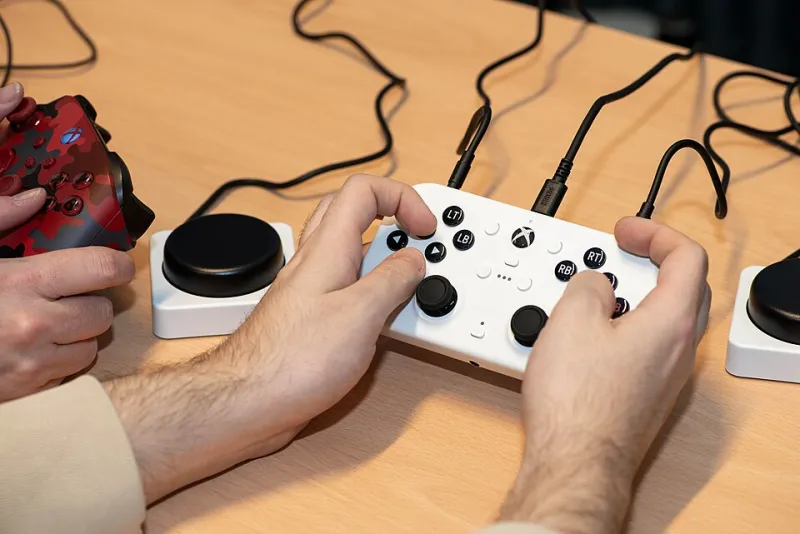
Photo: InclusiveGameLab, CC BY-SA 4.0, via Wikimedia Commons
You spent six months grinding ranked in one game. Your reaction time is razor sharp. Your positioning is automatic. Your thumbs move before your brain even finishes a thought. Then you fire up a different title — maybe a new release, maybe a game your squad wants to run — and suddenly you're a complete disaster. You're rolling when you should be dodging. You're pressing the wrong button to reload. You're timing your combos like you're still in the last game and whiffing every single one.
This isn't a mental block. It's not tilt. It's your nervous system doing exactly what it was trained to do — just in the wrong context.
What's Actually Happening Inside Your Brain
Muscle memory isn't stored in your muscles. It lives in a part of your brain called the basal ganglia, which handles procedural learning — the kind of knowledge that becomes so automatic you stop consciously thinking about it. When you've played hundreds of hours of a game, those input sequences get encoded at a deep neurological level. Your brain stops treating them as decisions and starts treating them as reflexes.
The problem is that the basal ganglia doesn't sort these memories by game title. It sorts them by similarity. So when you pick up a new action game that feels like your main, your brain starts pulling from the old playbook without asking permission. Button layouts that are 80% similar become a minefield because your hands keep drifting toward the 20% that's different. Timing windows that are close but not identical cause you to fire inputs either too early or too late, every single time.
Neuroscientists call this proactive interference — old learning actively blocking new learning. The more skilled you are at one game, the harder your brain fights to protect those existing pathways. Elite players aren't immune to this. In some ways, they're more vulnerable to it.
Why High-Level Players Get Hit the Hardest
Here's the counterintuitive part: casual players often adapt to new games faster than veterans. That sounds backwards, but it makes sense when you understand what's actually happening.
A casual player hasn't burned deep neural grooves into a specific control scheme. Their muscle memory is shallow, which means it doesn't fight back as hard when new information comes in. A veteran who's put in 2,000 hours has essentially built a superhighway of automatic behavior. Switching games doesn't just ask them to learn something new — it asks them to override something that's become nearly involuntary.
This is why you'll see pro players publicly struggle when they stream a different game. It's not that they suddenly got bad at gaming. Their hands are literally running interference against them.
The Habits That Transfer vs. The Ones That Betray You
Not all gaming skills are created equal when it comes to portability. Some things carry over beautifully across titles. Others become active liabilities.
What transfers well:
- Macro decision-making. Understanding when to push, when to back off, how to read momentum — these are game-agnostic skills that sharpen with experience across any competitive title.
- Screen awareness and map reading. If you've trained yourself to gather information from the full screen rather than tunnel-visioning, that habit moves with you.
- Mental composure under pressure. The ability to stay calm and systematic when things go sideways is universal.
- General hand-eye coordination. Raw aiming and tracking ability does transfer, especially within the same input device ecosystem.
What actively works against you:
- Specific button combos and input shortcuts. These are the most dangerous. Your hands will execute them automatically in situations that look familiar but aren't.
- Timing windows for defensive mechanics. Parry timing, dodge windows, block frames — these vary wildly between games and your body will default to what it already knows.
- Movement tech. Bunny hopping, dash canceling, wall running — each game's movement system has its own physics and input logic. Trying to apply one game's movement language to another will leave you looking like you've never touched a controller.
Practical Strategies to Protect Your Reflexes
So what do you actually do about this? The good news is that proactive interference isn't permanent, and there are concrete ways to manage it.
Create hard separation between your gaming sessions. Don't jump from your main game directly into a new one. Give your brain a buffer — even 20 to 30 minutes of something totally unrelated. This helps signal to your nervous system that it's time to switch contexts rather than extend the current one.
Don't skip the tutorial, even if it feels beneath you. High-level players almost always skip tutorials because they feel redundant. Resist that instinct when learning a new game. Tutorials aren't about learning the basics — they're about creating initial neural pathways in the correct direction before your old habits have a chance to colonize the new input scheme.
Remap controls deliberately. If a new game lets you customize your layout, don't just default to whatever the game suggests. Look at your primary game's control scheme and try to match the new game's layout as closely as logic allows. You won't be able to make it identical, but reducing the number of differences cuts down on interference significantly.
Play the new game in isolated blocks. Don't alternate between your main and a new title on the same day during the early learning phase. Spend full sessions in the new game until the basic inputs start feeling natural. Once the new muscle memory has some weight behind it, you can start mixing sessions again without as much bleed-over.
Verbalize what you're doing. This sounds weird, but talking through your inputs out loud while learning a new game activates different parts of your brain and forces conscious attention onto actions your hands want to run on autopilot. It slows you down at first, but it dramatically speeds up the encoding of correct new patterns.
The Long Game on Cross-Title Skill
The players who handle game-switching best aren't the ones with the fastest raw reflexes. They're the ones who've built a habit of conscious deliberateness early in any new game. They know their hands are going to lie to them at first, so they don't trust their instincts until those instincts have been rebuilt from the ground up in the new context.
There's something almost philosophical about it. The more power you've built in one game, the more carefully you have to disarm yourself when you walk into a new one. Real cross-game skill isn't about carrying your existing muscle memory forward — it's about knowing when to set it down.
Your hands will catch up. They always do. But you have to give the new game a real chance to write something new before your old game finishes writing over it.